Why problem-centricity matters now more than ever in an AI-saturated world.
We’re now in an era where technology evolves faster than individuals can learn and organisations can responsibly implement. Where the race to ‘start doing’ is outpacing the strategic, human and ethical oversight required to make sure we’re doing the ‘right things’ – not just doing things faster.
In this rush to adopt AI, it’s easy to mistake activity for progress. To mistake novel ideas for actionable solutions.
We’ve all likely found ourselves in an endless conversational loop with an AI engine – constantly reframing the ‘ask’ only to get further away from the outcome we actually need. Or sifting through rafts of AI-produced “work slop”: reports, concepts, and artefacts generated by outsourced tasks that were meant to save time, but instead introduced more noise, distraction, and downstream clean‑up.
With so much attention on prompt engineering, conversational fluency, and tool mastery - the how of using AI - it’s easy to lose sight of the most critical ingredient in any effective design journey: The why.
A crystal‑clear articulation of the problem we’re trying to solve.
A strong north star that anchors collaboration, filters outputs, and keeps human judgement in the loop.
Without this, even the most sophisticated AI toolkits will confidently optimise toward the wrong outcome—at unprecedented speed.
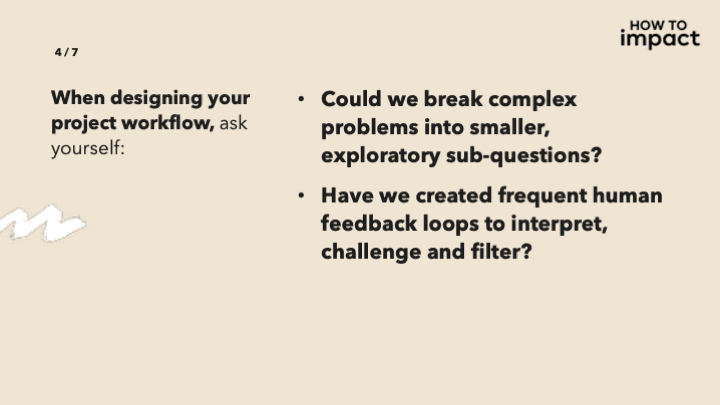
Swipe through the carousel to explore three key ingredients for maintaining problem-centricity when collaborating with AI.